


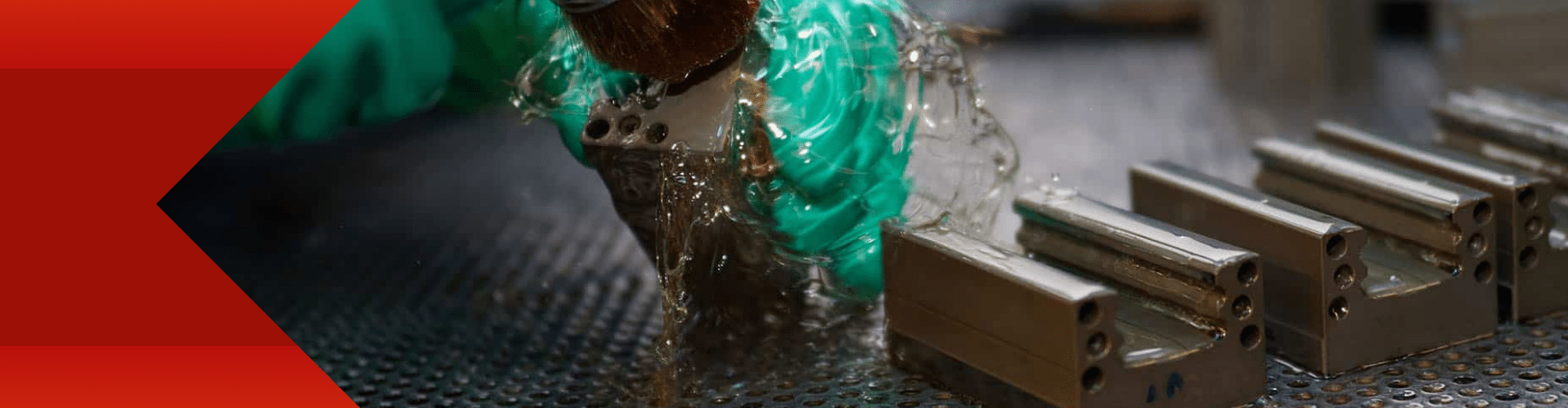
A linear guide forms the basis of many motion systems, but in practice lubrication is still sometimes neglected. As a result, production systems may come to an unnecessary standstill. To prevent downtime and actually achieve the calculated service life of recirculating ball carriages, we spoke with Richard Eshuis, application specialist and director of LM Systems. He explains how lubricating linear guides works in practice and what engineers and maintenance departments should pay attention to.
The importance of lubrication
A linear guide operates with balls or rollers moving between the carriage and the rail. Without sufficient lubrication, friction increases and the contact surfaces wear more quickly. Eshuis summarises the importance of lubrication clearly: “Lubrication is essential because it reduces friction, which in turn reduces wear. In addition, the lubricating grease keeps the seals flexible so that they continue to function properly.”
The lubricant also has a second important function. It keeps the seals flexible so that they continue to perform effectively. These seals ensure that grease remains inside the carriage and that dirt, dust and other contaminants are less able to enter. Proper lubrication therefore supports not only the movement itself, but also the protection of the guide.
Initial lubrication versus first commissioning
In practice, there is a common misconception that a new guide system can immediately be put into long-term production use. THK provides every new carriage with an initial lubrication after production. This first amount of lubricant is intended to create a lubricating film between the balls or rollers and the raceways and to protect the components against corrosion during transport and storage. According to Eshuis, however, this initial lubrication is not intended as full operating lubrication: “The initial lubrication is sufficient for testing the machine. Before commissioning the machine, everything must be properly relubricated.”
This means that the carriages must be lubricated with the correct amount of grease before the machine is put into full operation. Only then is the guide properly prepared for normal production conditions.
Grease or oil lubrication
For most applications, grease lubrication is the standard solution. Grease adheres well, remains in the carriage for a relatively long period and is practical from a maintenance perspective. For this reason, grease lubrication is commonly used as standard when lubricating linear guides in industrial machines.
Oil lubrication can be used when lower running resistance is required or when the application operates at higher speeds. Oil is better able to dissipate heat, but it requires a continuous lubrication system. The lines and lubrication points must therefore be configured so that the correct amount of oil reaches the carriages at the right time.
The choice between grease and oil therefore depends on the application. Factors such as speed, load, environment, temperature and maintenance strategy determine which lubricant is most suitable.
Determining the correct relubrication interval
The correct relubrication interval is not the same for every machine. It depends on environmental conditions, temperature, load, speed, acceleration and cycle time. Nevertheless, LM Systems uses clear guidelines for many common situations.
For traditional full-ball guides, a general guideline is a relubrication interval of approximately 100 kilometres. For guides with ball chain technology, this can increase to approximately 5,000 kilometres. If this distance is not reached due to low speeds or limited movement, LM Systems recommends lubricating at least twice a year because grease ages over time.
Eshuis emphasises that the interval should always be considered in relation to the application: “The relubrication interval depends on temperature, environment, load, speed, acceleration and cycle time.”
Recognising an incorrect amount of lubricant can help prevent further damage to the guide. Too little lubricant can often be heard or felt. The guide may start to run more roughly, produce more noise or require more force to move. Prolonged underlubrication can even lead to corrosion or tribocorrosion.
Too much grease can also cause problems. With overlubrication, excess grease accumulates at the ends of the carriage or at the end of the guide rail. This can result in higher running resistance and unnecessary contamination around the guide. Proper lubrication therefore does not simply mean adding a large amount of grease. It means using the correct quantity, at the right time and with the right lubricant.
Selecting the lubricant and lubrication points
THK offers several standard greases. In general, AFB grease is used, which is a lithium-based grease. For specific conditions, greases are also available that are suitable for applications such as the food industry or cleanroom environments.
A grease nipple is supplied with the carriage as standard. It is usually mounted on the end of the carriage. On many carriages, a grease nipple can also be fitted on the side. Versions with a lubrication connection on the top are also available.
If a grease nipple is difficult to reach with a grease gun, a lubrication adapter can be used. These adapters can also be connected to a central lubrication system. Grease is then supplied to the carriages through lines at fixed intervals. Are you planning to lubricate linear guides and would you like to know which grease, quantity or relubrication interval is suitable for your machine? Contact our engineers for technical support with your application.