


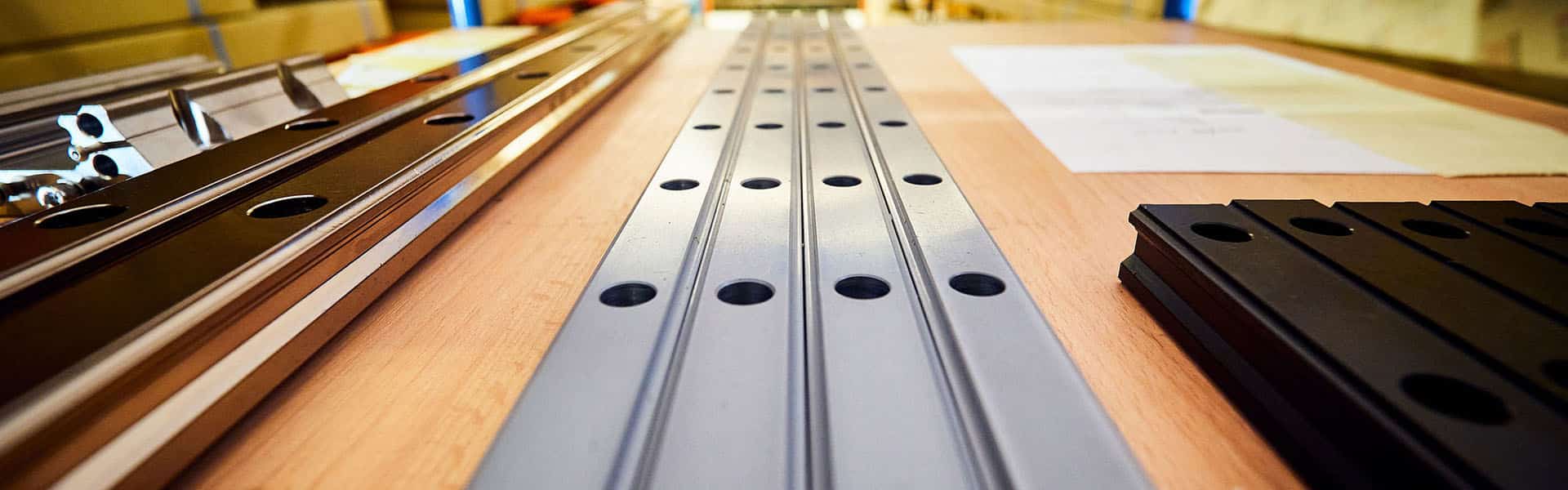
The precise guidance of moving components forms the foundation of a well-functioning machine design. In this context, a linear guide ensures that a machine component can move in a controlled, accurate and smooth straight line. At the same time, the guide system can absorb the forces and moment loads that occur during this movement.
In practice, the terms straight-line guide and linear guide are often used interchangeably. Both refer to a guidance system that allows a component to move in a controlled and smooth straight line. The term linear guide is widely used in practice, partly because various specific designs exist, such as recirculating ball guides and recirculating roller guides.
Design and components of a linear guide
A linear guide mechanism essentially consists of two main elements: a guide rail along which the movement takes place and a carriage. The carriage is the moving component that travels along the guide rail and supports the load.
The construction of such a carriage is technically sophisticated. At its core is a hardened and ground steel block. End caps are fitted to the front and rear of the carriage. These end caps guide the recirculating balls, with or without a ball chain, allowing smooth movement with low friction.
To support a long service life and consistent operation, seals are fitted to the end caps. These seals have a dual function. On the one hand, they retain the lubricating grease inside the carriage, as the balls must remain properly lubricated to minimise friction and wear. On the other hand, the seals prevent dust, dirt and other contaminants from the surrounding environment from entering the carriage.
Types of linear guides
Linear guides are available in various designs. The type best suited to your machine depends primarily on the required speed, accuracy, stiffness and load. In mechanical engineering, a distinction is often made between recirculating ball guides, recirculating roller guides, roller wheel guides and sliding guides.
- A recirculating ball guide uses circulating balls, with or without a ball chain, that move between the rail and the carriage. This provides low friction, smooth running and high accuracy. As a result, this type is highly suitable for applications involving high speeds and accelerations, such as pick-and-place systems, packaging machines and lighter mechanical engineering applications.
- A recirculating roller guide uses cylindrical rollers instead of balls. Because rollers provide a larger contact area than balls, they can accommodate higher forces and larger moments. This makes recirculating roller guides suitable for applications where stiffness and load capacity are important, for example in heavy mechanical engineering or machine tools where shock loads and varying loads occur.
- A roller wheel guide consists of a carriage with rollers that travels along a rail or profile. This type of guide is suitable for very high travel speeds of up to approximately ten metres per second. With the correct rollers, small alignment errors in the construction can also be accommodated. However, the maximum load capacity is lower than that of recirculating ball guides and recirculating roller guides.
- A sliding guide operates without balls or rollers. Instead, two sliding surfaces move directly against each other with the aid of oil or lubricating grease. This direct contact results in greater friction and wear than with guides that use rolling elements. Sliding guides are therefore mainly used at low speeds and under specific operating conditions.
Making the right choice
The choice between a recirculating ball guide and a recirculating roller guide is mainly determined by the speed, accuracy and expected mechanical load of the installation. Recirculating ball guides are widely used in lighter mechanical engineering, packaging machines and pick-and-place systems. In these situations, low friction, high speed and accurate positioning are important, while the forces to be absorbed remain relatively limited.
When very heavy loads or large moments are involved, a recirculating roller guide is often the more suitable choice. This is commonly seen in heavy machine tools, such as lathes and milling machines. In these machining applications, shock loads or varying forces often occur. The higher stiffness of rollers helps to limit deformation and support the required machining accuracy of the workpiece.
Common mistakes in selection and installation
In practice, our engineers regularly encounter misunderstandings when sizing and applying a linear guide. One common mistake is to base service life calculations solely on the maximum static or dynamic load, without taking an appropriate safety factor into account. Dynamic peak loads and unexpected shocks can shorten the actual service life if they are not considered during the design process.
In addition, the installation of a guide rail requires careful attention. Poor alignment of the rails creates additional internal forces in the carriages. These forces are not always included in standard service life calculations and can cause premature wear.
Finally, maintenance after commissioning is often overlooked. Everyone understands that a car requires regular servicing. However, in production environments, the need to periodically relubricate a carriage is sometimes forgotten. Without proper lubrication, friction increases and the carriage can become damaged.
Discover linear guides at LM Systems
LM Systems engineering support for linear guides
LM Systems supports you as an engineer or machine builder in selecting, sizing and applying the correct linear guide. We consider factors including load, speed, accuracy, stiffness, service life, alignment and installation conditions. In this way, we help prevent a guide from being selected solely on the basis of maximum load, while factors such as safety margin, shock loading, installation quality and maintenance are at least equally important for reliable operation in practice.
Would you like to take your design to the next level, or are you facing a technical problem that you cannot resolve yourself? Our engineers are ready to calculate your application and configure the optimal linear motion solution. Contact us to arrange a consultation with our specialists.