


Stick-slip is a jerky motion that can occur when a linear system starts moving from a standstill. The starting torque required to initiate movement is then higher than the torque needed to keep the system moving. This is because static friction is greater than dynamic friction. As soon as the resistance is overcome, the system briefly moves forward. It then slows down again, after which the same effect can occur repeatedly.
In linear technology, this is undesirable, particularly in applications involving precise positioning, low speeds or heavy loads. Motion should be smooth and predictable. When it is not, this can affect dimensional accuracy, product quality, wear and the behaviour of the drive system.
Stick-slip explained simply
A familiar example is a heavy object being pushed across a surface. Initially, relatively high force is required to get the object moving. Once it is moving, less force is needed. Something similar happens in linear motion. The transition from standstill to movement does not occur smoothly, but in small jerks.
The cause lies in the difference between static and dynamic friction. Static friction acts while two surfaces remain stationary relative to each other. Dynamic friction occurs once movement begins. When static friction is significantly higher, the system must first overcome greater resistance. This causes the characteristic jerky start.
With properly selected linear guides, this effect remains limited. Recirculating ball guides are naturally less susceptible to stick-slip because movement takes place through rolling elements. Nevertheless, the effect can still occur in practice when load, speed, lubrication or system stiffness are not properly matched.
When does stick-slip occur most often?
The occurrence of stick-slip is highly dependent on the application. There is therefore no fixed speed or load at which it will always occur. In practice, the effect is mainly seen at low speeds in combination with high loads.
At low speeds, there is less kinetic energy in the system. As a result, the transition between standstill and movement becomes more sensitive to differences in friction. At high loads, contact forces increase. If the lubrication, preload or construction is not properly suited to these conditions, movement may become less smooth.
The environment can also have an influence. Contamination, aged grease, an incorrect amount of lubricant or seals that do not move freely enough can increase resistance. This makes the starting torque higher and increases the likelihood of jerky motion.
The relationship between static and dynamic friction
There is no universally correct ratio between static and dynamic friction. The ratio depends on the type of guide, the load, lubrication and environmental conditions. For this reason, it is not useful to focus on a single value alone.
A linear system should always be assessed as a whole. The guide, drive, load, installation, lubrication and stiffness together determine the motion behaviour. If one element is not properly matched to the application, it can affect the transition from standstill to movement.
Preventing stick-slip therefore starts with a thorough analysis of the application. Is the axis vertical or horizontal, what mass is being moved, what is the speed, how frequently does the movement start and stop, and what level of accuracy is required? Only then can it be determined which measure will have the greatest effect.
Reducing stick-slip
There are several ways to prevent or reduce stick-slip. The correct solution depends on the cause. Lubrication, speed, load and system stiffness are often the first factors to consider.
Lubrication is a logical starting point. We always use lithium-based grease. Not only the type of grease is important, but also the correct quantity. Too little grease can result in higher resistance and faster wear. Too much grease, on the other hand, can create additional resistance, particularly at low speeds or with sensitive seals.
The lubrication interval must also be observed. Grease ages through both use and time. The base oil and additives change as the grease ages, reducing its lubricating performance. Regular maintenance helps keep motion smooth and prevents seals from becoming increasingly resistant.
Where the application allows, a higher speed can help make movement more uniform. Reducing the load can also have an effect. In other cases, the cause may not lie in the guide itself, but in the construction or drive system.
The influence of drive stiffness
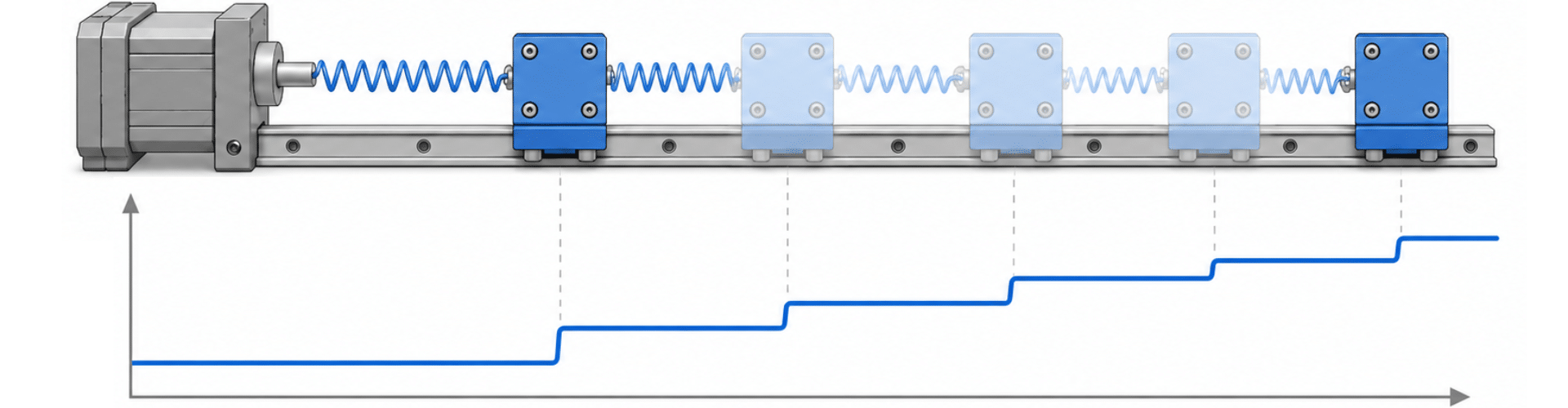
The stiffness of the drive system can have a significant influence on suppressing stick-slip. A ball screw has high axial stiffness. As a result, the drive responds more directly to motor movement and there is little elastic deformation in the drivetrain.
A timing belt behaves differently. A timing belt has elastic stretch. This allows energy to be temporarily stored in the belt and then released. This can intensify jerky behaviour, particularly at low speeds and higher loads.
A ball screw can help suppress this effect. Its high axial stiffness creates a more direct movement, making the transition from standstill to motion easier to control. This makes drive selection important for axes where positioning accuracy and smooth starting are key requirements.
Preventing stick-slip in practice starts with the right diagnosis
Preventing stick-slip requires looking at the complete linear system. Recirculating ball guides are naturally less susceptible to this phenomenon, but incorrect lubrication, high loads, low speeds or insufficient stiffness can still cause jerky movement.
A good approach therefore starts with identifying where the resistance is occurring. Based on that, the correct lubricant, grease quantity, lubrication interval, load level or a stiffer drive system can be selected. This helps keep linear motion more predictable and allows the system to start more smoothly from a standstill. Contact us today for targeted technical advice, or download the required 3D CAD files directly from the website to speed up the design process.