


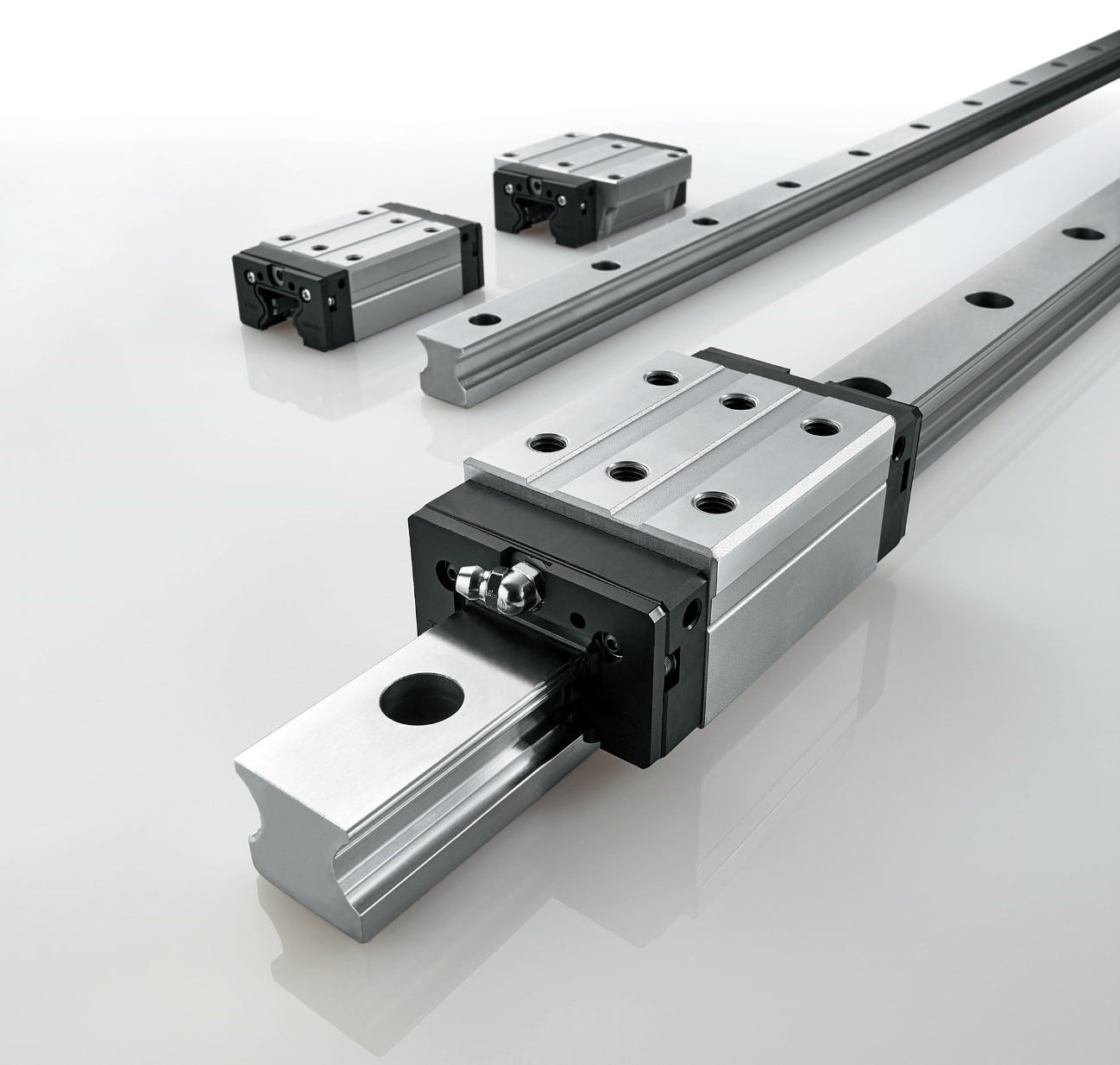
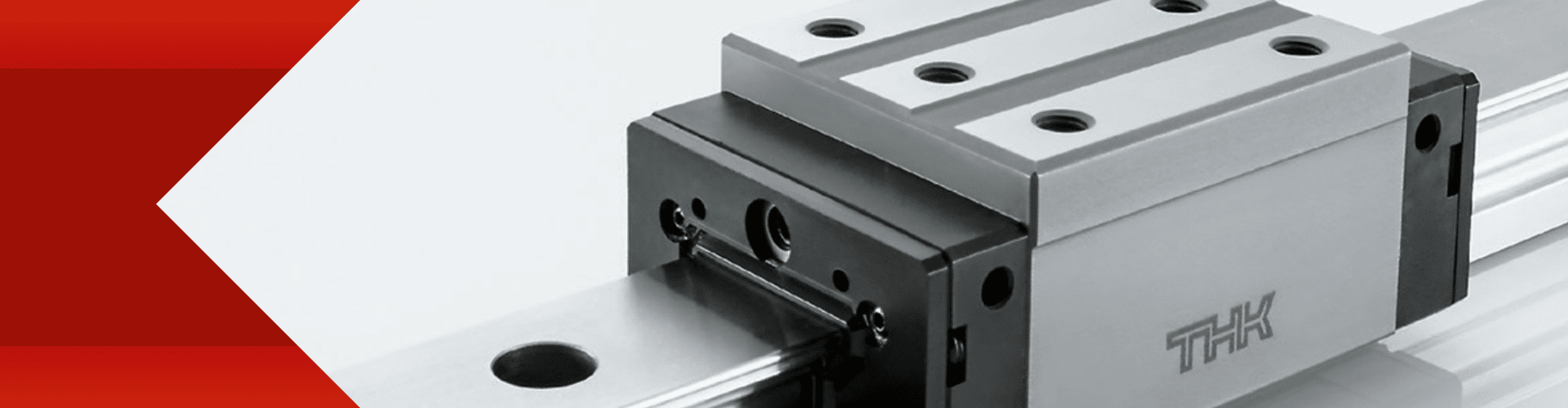
Why are the raceways of the THK HDR recirculating ball guide located specifically on the sides of the rail? And what does the DB structure inside the block provide? These design choices are directly related to the characteristics of this series. The HDR was developed for single-rail applications, offers high rigidity against tilting in the roll direction, and can accommodate the same load from four directions.
Compact single-rail applications
One profile rail as the basis for a single-axis table. That is the starting point of the THK HDR. A configuration consisting of one HDR and one ball screw makes it possible to build a compact and lightweight table structure. This series is therefore clearly aimed at applications where limited installation space and rigidity need to be combined.
Particularly in a single-rail structure like this, resistance to tilting requires additional attention. After all, the load is not distributed across two parallel rails. This is why much of the technical distinction of the HDR lies in its internal design.
The technology is located at the sides of the rail
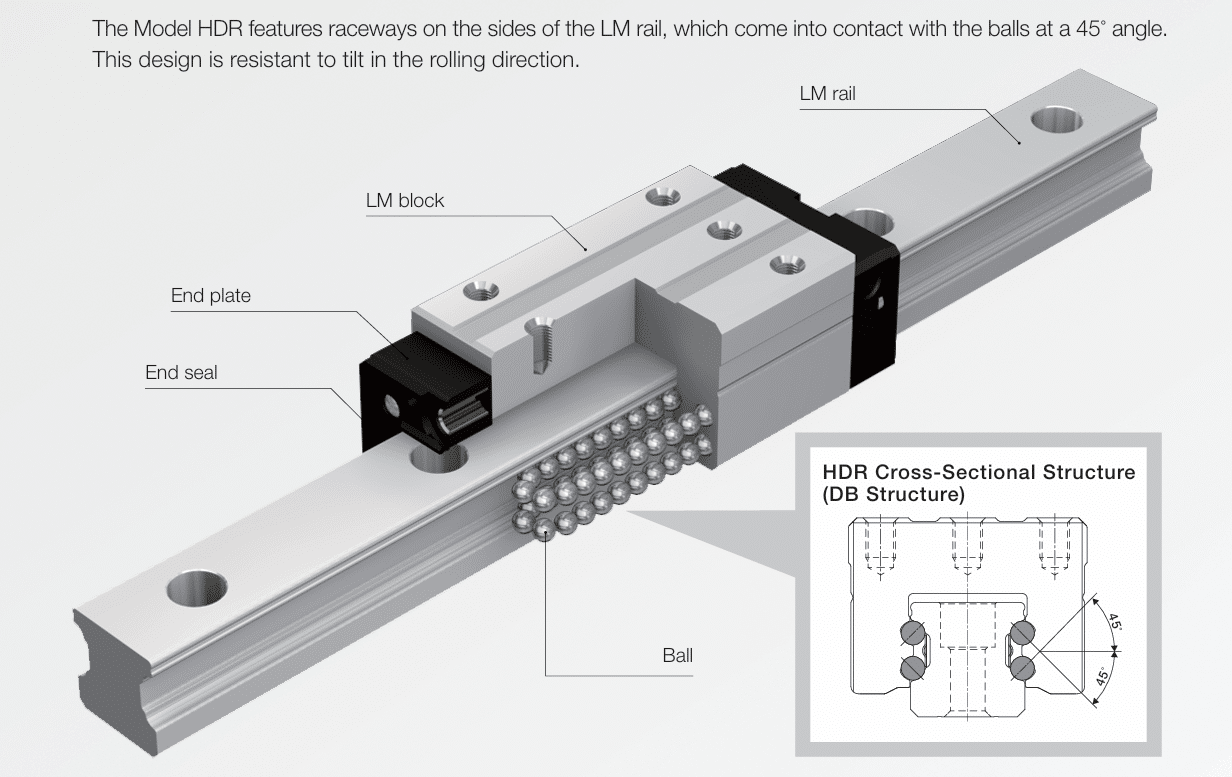
In the HDR, the raceways are located on both sides of the profile rail. The balls make contact with them at an angle of 45 degrees. In addition, the guide uses a DB structure, in which the contact lines are arranged back-to-back.
This is more than just a detail in the cross-section. When an Mc moment acts on the guide, this contact structure provides full support for the balls. This results in high rigidity and strong resistance to tilting in the roll direction. The principle is comparable to a back-to-back arrangement, as also used with angular contact bearings.
In this way, the various design choices work together effectively. A single rail requires a structure that can handle moment loads well. The THK HDR recirculating ball guide is specifically designed for this purpose.
The load can come from multiple directions
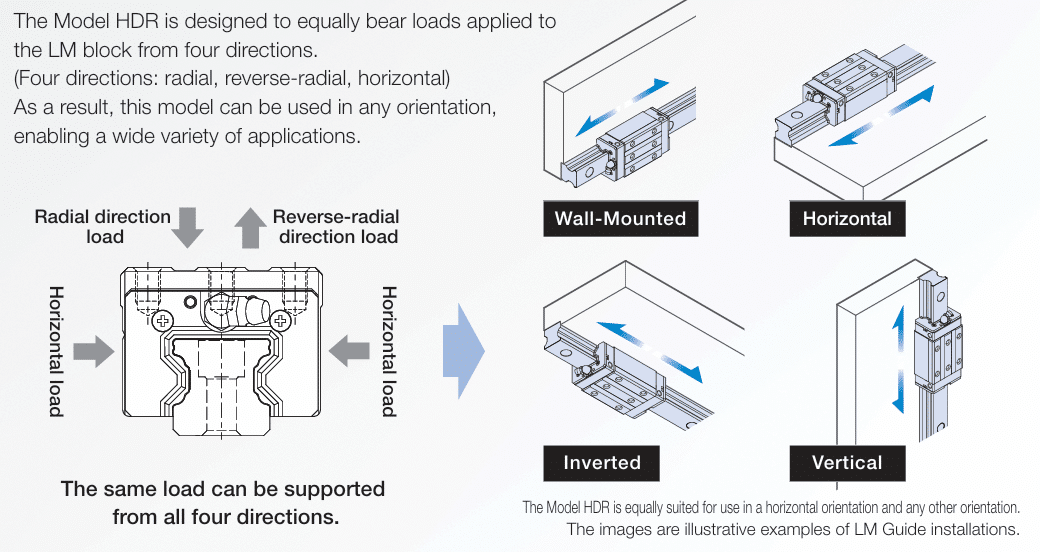
But there is more. The LM block is also designed to accommodate the same load from four directions. These are radial load, reverse radial load, and horizontal load from either side. This immediately provides greater freedom when it comes to mounting. The HDR can be installed horizontally, but also vertically, against a wall, or in an inverted position. This means you do not have to design around one fixed orientation.
From there, the selected version becomes particularly important. The size, block type, and actual load must, of course, be matched appropriately. However, the basic design itself is not limited to a single mounting position.
Preventing contamination
The side-mounted raceways offer a second advantage. Foreign material that lands on top of the rail is less likely to reach the ball raceways. The shape of the rail itself therefore already provides an initial level of protection.
For additional protection, a cover plate can be installed over the entire top surface of the rail. This plate improves the effectiveness of the seal and helps prevent foreign material from entering the LM block. Particularly where contamination can accumulate on the rail, this is a logical component of the configuration.
Several sealing combinations are also available.
- UU with end seals
- SS with end seals and side seals
- DD with double seals and side seals
- ZZ with end seals, side seals, and metal scrapers
- KK with double seals, side seals, and metal scrapers
This allows the level of protection to be matched to the amount and type of contamination around the rail.
For fine contaminants, LaCS is also available. This laminated contact scraper consists of three contact layers. Small foreign particles are therefore removed from the rail in several stages before they can enter the LM block.
Eight sizes and thirteen block types
The range within the HDR series is quite broad. Eight sizes are available, from 15 through 65. Within these sizes, thirteen block types are available.
○ = available
– = not available
| Type | Block type | HDR15 | HDR20 | HDR25 | HDR30 | HDR35 | HDR45 | HDR55 | HDR65 |
|---|---|---|---|---|---|---|---|---|---|
| Short | SC | ○ | ○ | ○ | ○ | ○ | – | – | – |
| Short | SR | – | ○ | – | – | – | – | – | – |
| Short | SV | ○ | – | ○ | ○ | ○ | – | – | – |
| Short | UV | – | ○ | ○ | – | – | – | – | – |
| Short | US | – | ○ | ○ | – | – | – | – | – |
| Standard | C | ○ | ○ | ○ | ○ | ○ | ○ | ○ | ○ |
| Standard | R | ○ | ○ | ○ | ○ | ○ | ○ | ○ | ○ |
| Standard | V | ○ | – | ○ | ○ | ○ | ○ | ○ | – |
| Standard | UW | – | ○ | ○ | – | – | – | – | – |
| Standard | UT | – | ○ | ○ | – | – | – | – | – |
| Long | LC | ○ | ○ | ○ | ○ | ○ | ○ | ○ | ○ |
| Long | LR | ○ | ○ | ○ | ○ | ○ | ○ | ○ | ○ |
| Long | LV | ○ | – | ○ | ○ | ○ | ○ | ○ | – |
Options within the design
With the number of available versions, there may be a temptation to select a size straight away. However, it is more logical to start by looking at the design itself. What load acts on the guide? How is the block mounted? How much space is available, and what level of protection is required?
From there, the selection becomes much more focused. First, determine what the guide needs to accommodate mechanically. Then select a suitable block design. Finally, consider the sealing and any additional protection against contamination.
This way, you use the characteristics of the HDR as intended and avoid making a selection based solely on dimensions.
LM Systems supplies every THK HDR recirculating ball guide with a customer-specific configuration tailored to the intended application. Would you like to know which configuration is best suited to your machine? Feel free to contact us for technical advice.