


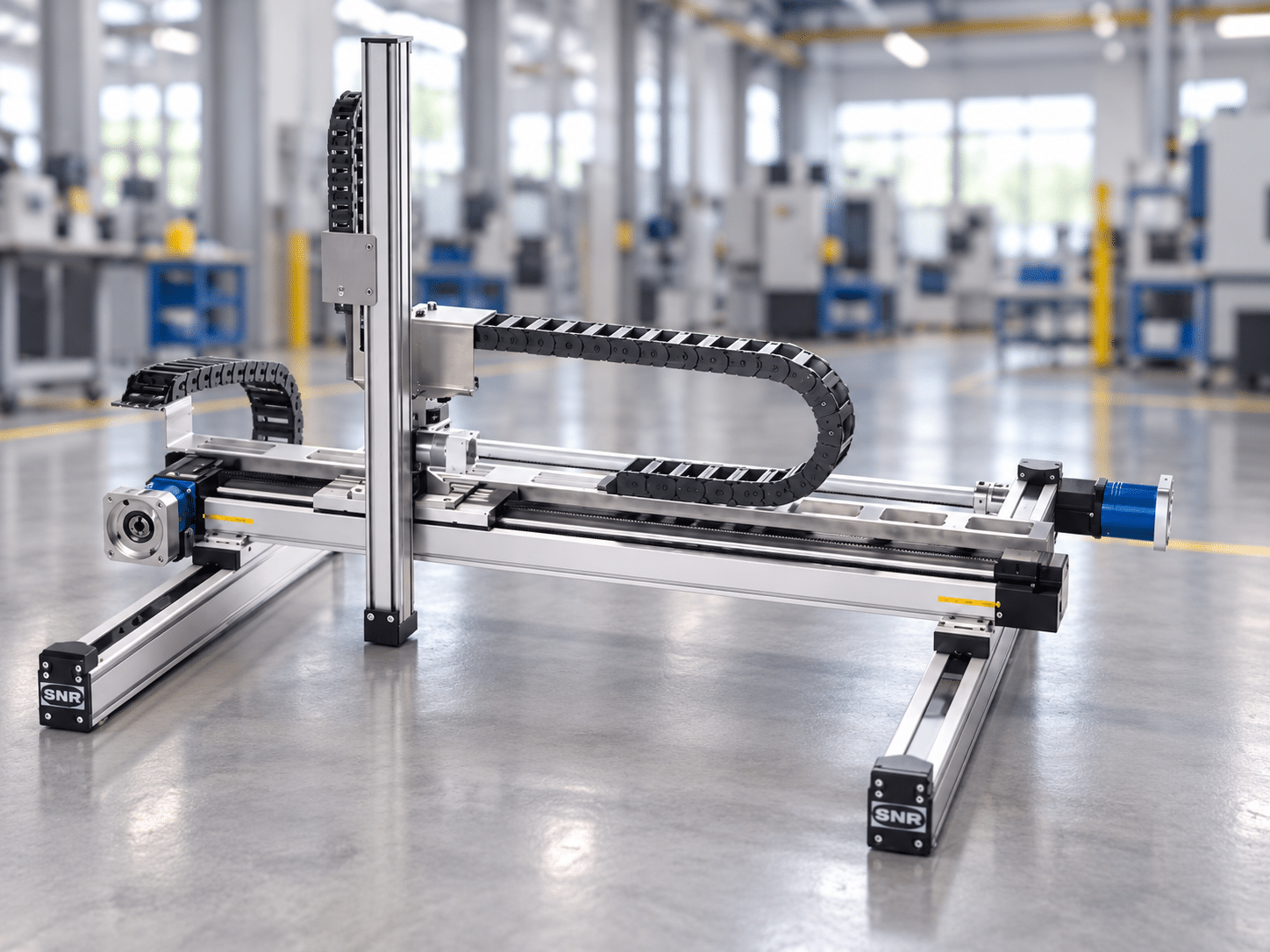
A compact linear drive that meets the technical requirements of a machine design. That is the principle behind the LinMotion Economic (LME) modules. These cost-effective linear modules combine a rigid aluminium structure with a timing belt drive and THK linear guides. Thanks to their modular design, a wide range of configurations is available for different loads and movements. From a single linear axis to a complete XYZ system. With customer-specific assembly, LinMotion offers a suitable solution for industrial automation and machine building.
Customised as standard with LinMotion Economic (LME) modules
The LME series was developed in response to the need for cost-effective linear drives with the proven quality of THK linear guides. The product range combines standard components with the flexibility of customer-specific assembly. This allows linear modules to be configured according to the required dimensions, loads and movements.
The aluminium profiles are designed to provide high stiffness in a compact structure. The integrated timing belt drive provides linear movement. The linear guide supports the moving table and carries the load.
This design makes the modules suitable for a wide range of industrial applications, including product transfer, automated handling, positioning systems and machine structures with multiple axes of motion.
Timing belt drive for fast and precise movements
The LME modules use steel-reinforced HTD polyurethane timing belts. These timing belts are designed to withstand high forces and are installed with preload. This ensures that the drive continues to operate accurately during linear movement.
The parabolic tooth profile reduces noise levels. Depending on the selected THK guide, speeds of up to 5 m/s are possible. This makes the series an attractive option for applications requiring short cycle times and rapid movements.
The combination of a timing belt and linear guide enables both individual movements and parallel axes. Different modules can also be combined to create XY or XYZ positioning systems.
The different LME modules in the product range
The LME range includes several sizes, each with its own dimensions and technical capabilities. This allows the configuration to be adapted to the available installation space and load requirements.
The LME20 is the compact version within the series. The LME40 and LME60 offer greater capacity for applications involving higher forces. For larger loads and heavier machine structures, the LME80 and LME100 are available. Different THK guides can be used within these sizes.
The technical catalogue describes these five models. In more recent information from 2026, LM Systems refers to six profile sizes. The LME120 also appears in the CAD documentation. For this additional version, the current configuration options and specifications must be confirmed for each application.
More technical data, dimensions and available configurations can be found on the LME product page of LM Systems.
The right linear guide for every application
The THK linear guide largely determines the loads the module can handle. That is why the LME series offers several guide variants.
For cost-effective applications, the conventional HSV guide is among the options available. This guide uses individual balls and, according to the catalogue, is also suitable for certain environments with contamination.
For demanding and highly dynamic applications, guides with ball cage technology are available. The SRS, SSR, SHS and SHW variants offer different capabilities in terms of load capacity, running resistance and moment loads.
Ball cage technology ensures smooth movement with low noise levels. The catalogue specifies lubrication intervals of up to 5,000 kilometres, depending on the configuration and operating conditions.
Selecting the right LinMotion Economic (LME) modules
Choosing a suitable module starts with the actual load. Weight is not the only factor. The position of the load, required stroke length and acceleration also determine which configuration is suitable.
Moment loads on the linear guide are particularly important when dealing with overhung loads. A load positioned away from the centre of the moving table creates additional forces on the guide. As a result, a different THK configuration may be required, even if the weight remains the same.
It is also important to distinguish between the maximum timing belt load and the load capacity of the linear guide. The specified belt load does not directly indicate how many kilograms a module can move during operation.
By accurately calculating forces, moments and dynamic loads, oversizing can be avoided. This ensures that the module selection remains technically sound and cost-efficient.
Modular customisation and short lead times
In addition to standard configurations, LinMotion offers various options for further customisation. These include motor adapter flanges, gearboxes, inductive sensors, coupling shafts and mounting components.
The modular design makes it possible to adapt a linear drive to the machine design. This eliminates the need to select and assemble every component individually. It saves engineering time and simplifies integration.
Some of the LinMotion Economic (LME) modules are assembled in Germany. Assembly also takes place at LinMotion in Veenendaal. With technical support for design, calculations and configuration, LM Systems supports the entire process, from customer requirements to a complete module.
An LME module tailored to the machine design
From a compact linear axis to a combined positioning system, the LME series offers various options for a customer-specific solution. By coordinating the drive system, linear guide and mounting arrangement during the design phase, the technical configuration becomes clearer. LM Systems provides support with engineering expertise and CAD documentation. Explore the technical information and 3D configurations of the LME modules and discover which version best suits your design.