



A linear module is an integrated unit that converts rotational motion into precise linear movement, with both the guide and drive fully enclosed in a housing (often an aluminum profile). These ready-to-use systems relieve engineers by eliminating complex calculations related to stiffness, alignment, and critical speeds. In this article, we explain the differences between linear modules.
Drive principles and their mechanical properties
When selecting a linear axis, we primarily look at dynamics and required precision. Although many variations exist, most industrial applications fall into three main technological categories. Below are some key differences between linear modules.
1. timing belt-driven modules
The timing belt module is the “sprinter” among linear axes. At LinMotion, we most often use it in pick-and-place applications and packaging lines. The drive consists of a polyurethane belt reinforced with steel or carbon.
Timing belt modules are ideal for applications requiring high speeds (up to 5 m/s or more) and long strokes. Because the belt remains relatively lightweight over large distances, mass inertia is favorable. Positioning accuracy is lower than with a screw drive due to belt elasticity, and stiffness under varying loads is a point of attention.
2. ball screw modules
When a process demands micrometers rather than millimeters, the ball screw is the standard solution. In this case, the module functions as a powerful and rigid actuator.
These modules are ideal for vertical axes (Z-axes), heavy loads, and applications requiring high repeatability (up to ± 0.01 mm). The screw provides high axial stiffness, which is essential for machining processes or precise positioning under load. Maximum speed is limited by the critical speed of the screw; at very long strokes, the screw may start to “whip” unless additional supports are applied.
3. linear motors
For semiconductor applications or high-end assembly where every millisecond counts, we use linear motors. These systems have no mechanical transmission (no belt or screw); motion is generated through magnetic fields. This results in an almost wear-free system with extremely high accelerations.
Multi-axis systems
A single axis is often just the starting point. By combining modules, we create systems capable of performing complex spatial movements.
- XY configuration: two horizontal axes mounted on top of each other, commonly used in cutting machines or for positioning components on a work surface
- XYZ / gantry systems: a vertical Z-axis is added to an XY setup. For larger spans on the Y-axis, we often use an “H-gantry,” where two parallel X-axes are driven synchronously to minimize tilting moments and maximize stiffness
- Telescopic modules: a specific solution for warehouse automation or installations with limited installation length. The module can extend beyond its base length, which is essential for reaching into narrow aisles
Build yourself or buy a complete module?
For engineers, it can be tempting to assemble an axis from individual linear guides, a screw, and a motor mount. From a technical and economic perspective, however, a ready-to-use module from LinMotion is often the higher-quality choice.
First, it saves a significant amount of engineering time. You do not need to calculate mounting tolerances or simulate the stiffness of the aluminum profile—this has already been done. Second, there is a logistical advantage for procurement: instead of managing hundreds of individual components (bearings, bolts, seals, screws), you handle a single part number and one invoice. This reduces the risk of assembly errors and significantly shortens machine build time.
In addition, modifications can be carried out in our own workshop that are difficult for standard machine builders, such as applying specialized coatings for the food industry or filling systems with cleanroom-compatible lubricants.
Collaborating with our engineers
The power of hundreds of kilograms in motion
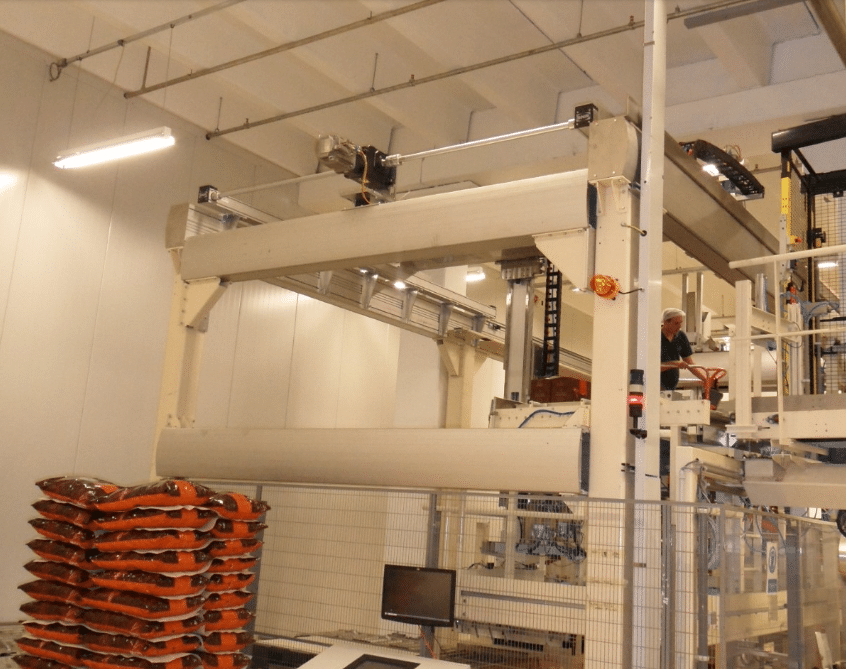
To illustrate our engineering capabilities, consider a project for a Belgian chocolate manufacturer. The challenge was to design an XYZ manipulator for handling heavy bags of cocoa beans.
In this case, speed was not the main challenge, but the moment load on the Z-axis. This vertical axis carried a load of 535 kg, including a rotary axis. The specifications were demanding: a Z stroke of 2,500 mm, a Y span of 5 meters, and X-axes up to 12 meters long. By using robust ball screw modules for vertical motion and synchronized timing belt modules for the long X stroke, we delivered a system that maintained high repeatability despite the large masses involved.
How do you select the right solution?
Selecting the right module starts with the load furthest from the base: the Z-axis. At LM Systems, we follow a structured methodology to ensure reliability:
- Z-axis calculation: determine effective load, acceleration, and required torque to hold the load against gravity
- Y-axis calculation: this axis carries the entire Z-axis; deflection and moment loads (Mx, My, Mz) are critical
- X-axis calculation: the system base; focus on parallelism and synchronization
By calculating service life for each axis based on dynamic load ratings (C), we can accurately predict maintenance intervals. This prevents unplanned downtime and ensures the quality associated with LM Systems.
Support for your next project
Choose the expertise of LM Systems and our LinMotion brand to minimize your engineering time and maximize machine reliability. Instead of dealing with complex calculations and exploring the differences between linear modules yourself, we provide fully assembled solutions, from high-speed timing belt systems to ultra-precise ball screw modules.
Through in-depth load and service life calculations for each axis (XYZ), we eliminate your design risk entirely. With a single invoice and a ready-to-use system that meets the strictest tolerances, you create peace of mind in your process and a competitive advantage in your market. Contact us to discover what customization can mean for your application.