


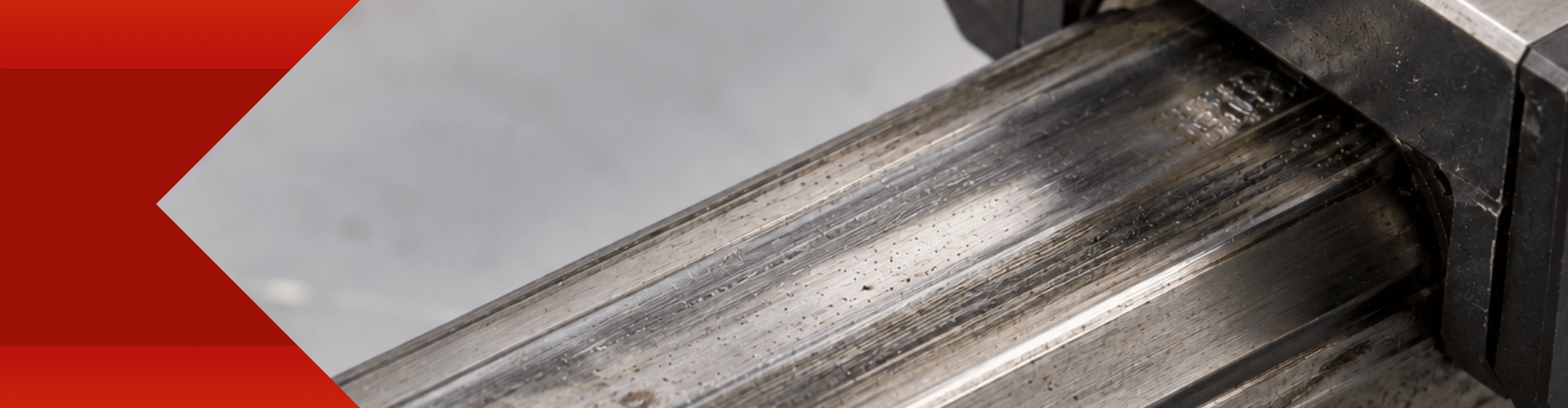
In practice, profile rail wear is often not caused by a single incorrect component choice. Usually, it is the result of a combination of load, installation and operating conditions. A profile rail may appear to be correctly sized, while an unfavourable moment load, incorrect alignment or inadequate lubrication can still lead to high local loads. A proper assessment of the wear pattern therefore provides valuable information about what is happening technically within the system.
Which technical causes lead to profile rail wear?
With profile rails, the cause of accelerated wear often lies within the overall motion system. Simply checking whether the rail’s nominal load capacity is sufficient therefore does not provide the complete picture. Forces, moments, installation, motion and environmental conditions together determine what the raceways and carriages actually have to withstand.
The ten most common technical causes are:
- Incorrect or excessive loading
- Incorrect alignment or insufficient flatness of the mounting surfaces
- Insufficient or incorrect lubrication
- Contamination
- Incorrect preload
- Dynamic loads
- Incorrect load distribution across multiple carriages
- Installation errors
- Incorrect sizing of the rail/carriage
- Insufficient consideration of environmental conditions
What does the wear pattern tell you?
The damage itself is often an initial technical indication. The wear pattern does not automatically prove what the cause is, but it does help to focus the investigation in the right direction. The table below provides an overview of wear patterns and their likely technical causes:
| Wear pattern | Likely technical cause |
|---|---|
| Uniform wear across the entire raceway | Normal service life / loading |
| Wear mainly on one side | Misalignment, poor alignment or moment loading |
| Localised damage/pitting | Overloading, shock loading or fatigue |
| Staining, discolouration or damaged raceways | Insufficient/incorrect lubrication |
| Pits or indentations in the raceway | ontamination, overloading or static impact |
| Rust/corrosion | Moisture, condensation, an aggressive environment or tribocorrosion |
| Shiny/polished areas | Abnormal contact loading or insufficient lubrication |
| Wear on multiple carriages, but with major differences between the raceways of each carriage | Uneven load distribution / geometrical error |
| Damage around one specific position on the rail | Repeated local loading or contamination |
| Increased play or noticeable vibration | Wear, incorrect preload or insufficient stiffness |
When is wear normal?
Normal wear generally develops in a predictable and even manner. Abnormal wear is more often localised, asymmetrical or occurs much earlier than would be expected based on the calculated service life. Warning signs include, for example, one carriage wearing significantly faster than the others, wear concentrated on one side, or localised damage and indentations.
Discolouration caused by heat or insufficient lubrication also requires attention. The same applies to rust, pitting corrosion, contamination-related damage, increasing noise, vibration or suddenly developing play. Changes in the process should also be taken into account. If wear increases significantly after changes to speed, load or machine settings, this may form part of the explanation.
Design errors that shorten service life
In many cases, the profile rail or carriage itself has not been selected incorrectly. Instead, assumptions made during the design phase do not always correspond with actual operating conditions. A calculation based solely on static loading, for example, may be insufficient once accelerations, moments or an unfavourable centre of mass come into play.
It is therefore useful to assess the complete linear motion system. Start with loads and moments. Then examine the motion profile, required stiffness, alignment, preload, lubrication, environmental conditions and desired service life. This allows you to assess not only the component itself, but also the system in which that component is required to operate.
Enginering support from LM Systems
Reducing profile rail wear during the design phase
It is not possible to prevent profile rail wear completely. However, much premature and abnormal wear can be prevented during the design phase. The greatest improvement does not necessarily come from selecting a stronger rail, but from designing the overall structure correctly.
This starts with correct sizing and proper load distribution. This should be followed by a rigid, dimensionally stable structure and correct alignment and installation. The preload must be appropriate for the application. Lubrication and sealing must be matched to the speed, usage and environmental conditions. At LM Systems, we can validate the complete linear motion system as part of this process. This gives you insight into whether the rail, carriages and structure are suitable for the actual application when considered as a single system.
Contact one of our experts to have the complete linear motion system assessed and determine precisely which adjustment is required.