


Linear motion is a displacement along a straight line. This type of motion is very common in machines. Think of a carriage moving back and forth, a gripper moving a product, or a tool moving in a controlled manner to a specific position. In such cases, forces often need to be transmitted, the moving mass needs to be accelerated and decelerated, and the structure must maintain the required accuracy. The drive and the guidance system work together to achieve this.
At LM Systems, we work with this type of motion on a daily basis. In the article below, you can read everything about this motion in one dimension.
What is linear motion?
In linear motion, the position of an object changes along a single straight axis. This differs from rotary motion, in which a component rotates around a centre point. Many electric motors naturally produce rotary motion. In machines, this rotation therefore often needs to be converted into linear displacement. Various mechanical principles can be used to achieve this.
Linear motion can take place continuously, but it can also move back and forth between two positions. In addition, the motion can consist of short positioning steps or, conversely, longer displacements at a constant speed.
How is this motion generated?
A commonly used product is a ball screw. In this system, a screw rotates while a nut moves along the screw. Balls between the two components provide rolling contact. This creates a controlled conversion from rotary to linear motion.
Another well-known product is a rack and pinion. A rotating gear engages with a straight rack. The rotation of the gear creates linear motion. This principle is used, among other things, for longer travel distances.
Linear modules are also widely used. Such a module combines several components involved in the motion into a single mechanical unit. Depending on the design, the drive can operate using a screw, timing belt or rack and pinion.
Within our product range at LM Systems, we work with, among other things, ball screws, rack and pinion systems and linear modules to achieve linear motion from a technical perspective.
Other mechanisms are also available. A crank-and-connecting-rod mechanism converts rotary motion into reciprocating motion. This principle is, for example, well known from piston engines. A chain can also be used to move an object along a straight path.
Guidance and drive have different functions
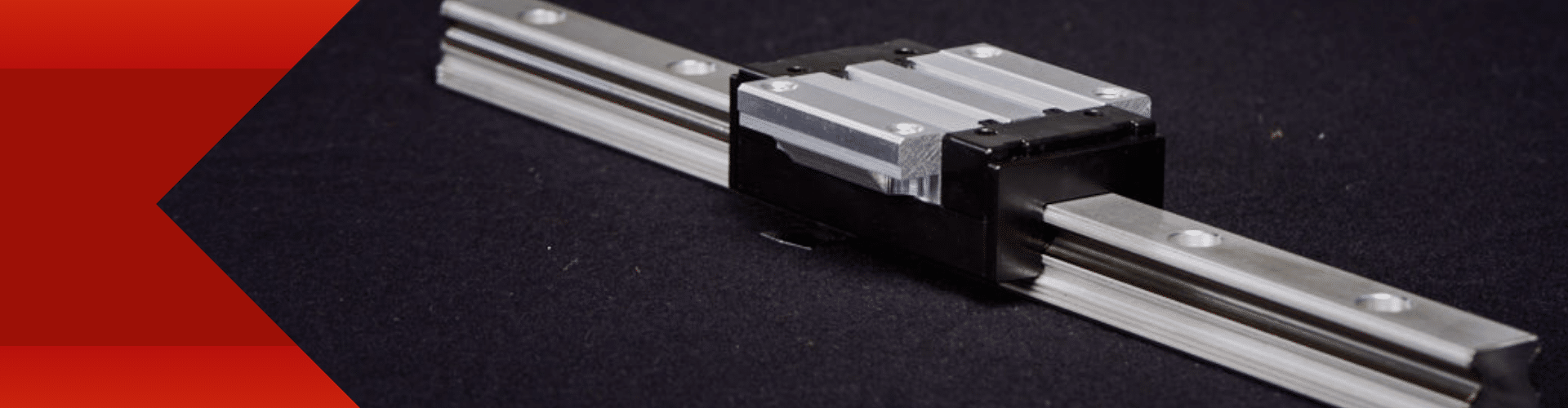
In linear motion, guidance and drive are often mentioned in the same breath, but they have different functions. The drive provides the force used to move a component. The guidance system determines the path of motion and absorbs forces and moments that do not act in the direction of motion.
A linear guide must prevent a moving component from rotating, tilting or moving sideways unintentionally. The design therefore partly determines how accurately and stably the motion takes place.
The behaviour of the motion
A linear system is characterised not only by the distance travelled. The motion profile also affects the forces within the structure. Speed indicates how quickly an object moves. Acceleration describes how quickly that speed changes. There is also the concept of jerk. This refers to the change in acceleration per unit of time.
A rapid change in acceleration can cause additional dynamic loads. As a result, a system may be subjected to different forces during acceleration than during motion at a constant speed. Mass and load also have a considerable influence on the behaviour of the motion. A heavy carriage, for example, requires more force to achieve the same acceleration than a light carriage.
Linear motion and automation
Machines often perform movements at higher speeds and with shorter cycle times. At the same time, positions, accelerations and motion profiles are controlled with increasing precision. As a result, motion is not determined by mechanics alone. Motors, sensors, encoders and control technology work together with the mechanical components. Modern linear motion is therefore often the result of several disciplines working together.
Mechanics determine how forces are transmitted and absorbed. The drive provides the motion. The control system determines when and how quickly that motion takes place. The characteristics of linear motion therefore have a direct influence on the rest of a machine.
Do you have questions about linear motion, how linear components work or the technical factors involved? Our experts at LM Systems will be happy to work with you and answer your questions based on your application and technical situation.
en technische situatie.