


In modern handling applications, linear systems regularly have to deal with extreme motion profiles. This can sometimes cause jerk and torsion in linear guides: abrupt movements that increase moment loads on the guides. These phenomena directly affect the carriages through unfavourable force distributions. Understanding the theoretical background and the effect on dynamic load ratings helps you, as an engineer, work towards a stable and predictable machine construction.
Movements that increase moment loads on guides
When a linear guide moves within a handling system, position, speed, and acceleration are constantly changing. In mechanical engineering, the change in acceleration per unit of time is referred to as jerk. In linear guides, high jerk means that the acceleration changes very abruptly.
High jerk can cause sudden inertial forces. Because the centre of gravity of the moving mass is often located at a certain distance from the guide in practice, this also creates a moment on the carriages. At high jerk values, short-term moment peaks can occur, making the load distribution across the carriages less favourable.
This can affect the service life of the mechanical system. In such situations, the dynamic load is higher than what is always fully accounted for in a standard calculation. As a result, balls or rollers may be loaded less evenly, potentially causing additional wear. Vibrations and resonances can also lead to greater shock loads on the carriages. In some cases, this also reduces the positioning accuracy of the machine.
The three moment directions in linear guides
In addition to high jerk values, torsion can also play an important role. Torsion is a twisting load, or torque, around the guide. This load occurs when the load is not mounted neatly in line with the guide.
This happens, for example, when a heavy load hangs far outside the centre of the carriage. Torsion can also occur with parallel guides when the load is mounted asymmetrically. A protruding arm can likewise cause a rotational force on the carriage or carriages.
In engineering, three moment directions are distinguished:
- Roll (Ma): the moment around the direction of travel of the rail.
- Pitch (Mb): the moment around the transverse axis of the system.
- Yaw (Mz): the moment around the vertical axis of the linear components.
Vulnerable applications in practice
Problems caused by jerk and torsion in linear guides mainly occur in handling systems and high-speed machines. Examples include flying shear movements, fast pick-and-place systems, gantry systems, portals, and packaging machines.
In these applications, acceleration and deceleration alternate at high speed. As a result, linear guides, carriages, and the surrounding construction are subjected to heavier dynamic loads.
Calculation methods and structural solutions
During the engineering process, LM Systems takes dynamic forces and moment loads into account in broad terms. The influence of jerk is usually included indirectly through the selected acceleration and an appropriate dynamic safety factor. This makes the design risk for the machine builder more manageable.
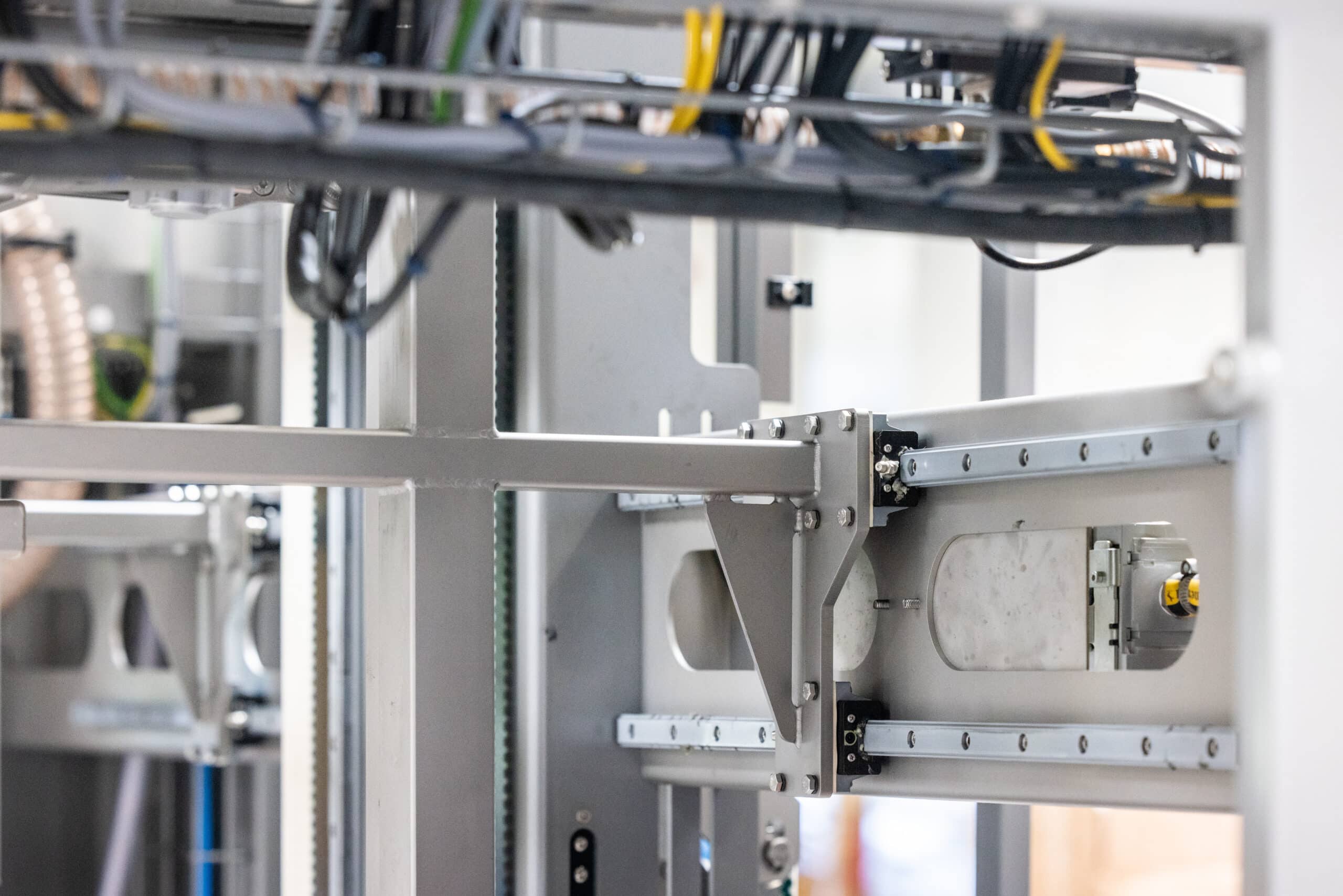
Rigidity, rail spacing, and the overall structural layout also play a major role in absorbing torsional loads. The distance between two parallel rails is often one of the most effective ways to absorb torsional forces. A rigid construction then helps distribute the load more evenly across the carriages.
This results in fewer peak loads and limits tilting or twisting. It directly contributes to higher positioning accuracy and a more reliable machine system.
To limit high jerk values in practice, it helps to program an S-curve profile in the motion controller. With this approach, acceleration is built up gradually instead of abruptly. When a standard solution is not sufficient, additional engineering may be required to better align the construction, rail spacing, carriage configuration, or motion settings with the application.
When should you seek help?
Are you experiencing vibrations or premature wear in your current gantry or packaging system due to abrupt movements? Our specialists will be happy to review the structural layout with you and assess whether jerk and torsion are present in the linear guides. Schedule a no-obligation consultation and discover our options for customer-specific customisation and engineering support.