


Backdriving occurs when an external force or a moving mass drives a linear actuator in reverse. In that case, the motion does not originate from the motor, but from the load itself. This occurs particularly often with vertical axes and efficient ball screws. Under the influence of gravity, the mass can cause movement as soon as the drive torque is lost. But which factors determine backdriving, and how should it be taken into account in the design? We explain this in the article below.
What is backdriving?
With backdriving, a linear actuator is driven in reverse by the load. An external axial force may, for example, cause the nut of a screw to move. This linear motion then causes the screw or motor shaft to rotate. The normal direction of force transmission through the drive train is therefore reversed.
A well-known example is a vertical axis with a ball screw. When the motor torque is lost, the mass on the carriage continues to exert a downward force. Due to the high efficiency and relatively low internal friction of a ball screw, this force may be sufficient to cause backdriving.
Sensitivity to backdriving is therefore not solely a characteristic of the screw itself. The complete combination of drive, load, transmission, structure and direction of motion determines how the system responds.
Backdriving and backlash
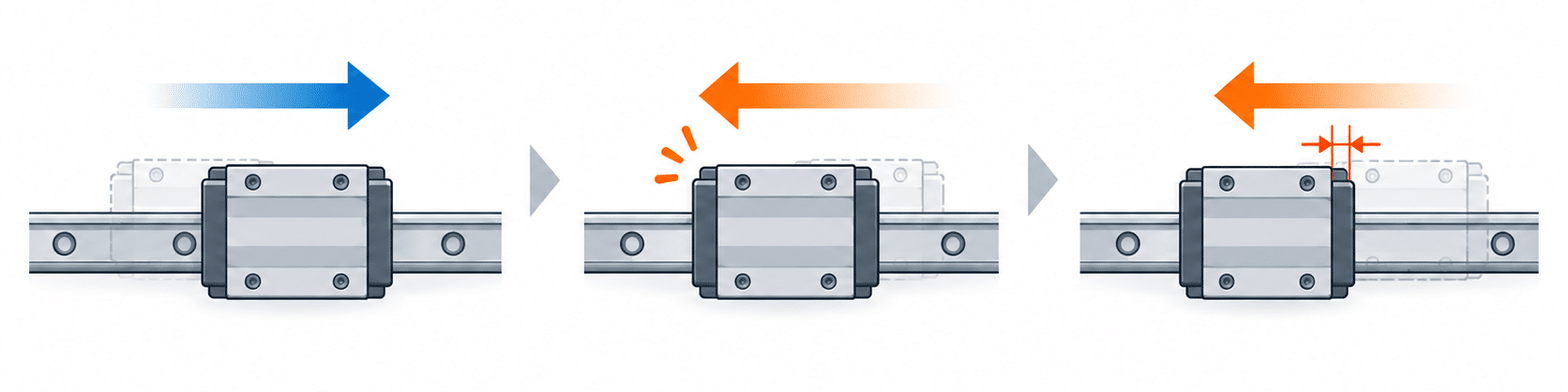
The terms backdriving and backlash are regularly used in the same context. However, they describe different phenomena. Backlash is play that becomes apparent when the direction of motion changes. The motor may, for example, already rotate slightly in the opposite direction while the carriage is still stationary. The existing mechanical play must first be taken up. Only after that does the carriage actually begin to move.
This play can occur at various points. Examples include the screw-and-nut combination, gears, belt drives, couplings or linear guides. Wear, incorrect preload and improper alignment can also affect the motion behaviour.
Not every delay during a change in direction is, however, genuine mechanical play. A flexible coupling, belt or structure may first deform elastically before movement becomes visible at the output.
Backdriving therefore concerns something different. In this case, the drive is driven in reverse by the load itself. A preloaded ball screw can reduce axial play, but this does not automatically prevent an external force from setting the drive in motion.
A limited amount of backlash does not necessarily have to be a problem either. When positioning accuracy is less critical and the motion takes place mainly in one direction, a predictable amount of play may be acceptable. In applications with frequent changes in direction and high positioning requirements, that same amount of play becomes much more relevant.
Which factors determine sensitivity to backdriving?
Whether a drive is actually backdriven depends on several technical characteristics.
-
Transmission ratio. A higher mechanical reduction generally makes backdriving more difficult.
-
Screw lead. A coarse lead is generally more susceptible to backdriving than a finer lead.
-
Drive efficiency. An efficient ball screw has relatively low losses. As a result, an external load can set the drive in motion more easily.
-
External force and mass. The greater the axial force or mass, the greater the force available to overcome resistance within the drive.
-
Axis orientation. With a vertical axis, gravity acts directly on the moving mass.
-
Dynamics and condition. Acceleration, stored energy, elasticity, wear and changing friction influence the behaviour over the system’s service life.
Friction requires some nuance in this respect. Greater friction can resist backdriving, but that resistance is not always constant. Lubrication, temperature, wear and the condition of components can change the behaviour.
For this reason, friction alone is not a reliable method for keeping a heavily loaded or vertical axis in position.
Vertical and horizontal backdriving
With a vertical axis, gravity remains present even when the motor no longer provides torque. As a result, a load can backdrive the system after shutdown, loss of power or a fault. The carriage may then move downwards while the screw is driven by the load.
This does not mean that every vertical screw-driven axis will automatically move downwards. The actual behaviour is determined by factors including the mass, screw lead, transmission ratio, internal resistance and any holding devices that are present. It is precisely this combination that makes it important not to rely on a single component characteristic. For an axis where backdriving could lead to unwanted movement, a motor brake, mechanical locking device or another holding mechanism may be required.
Backdriving is not only relevant to a stationary load. A moving mass contains kinetic energy. When a drive is switched off or stops suddenly, that energy may still cause movement. Elastic components introduce a second effect. Couplings, belts and structural components can deform under load and store energy. When the load changes, that energy may later be released again.
This means that the behaviour of a drive system can sometimes be more complex than simply determining whether or not a screw can be backdriven.
What are the consequences of unwanted backdriving?
Unintended backdriving can mean that an axis loses its position as soon as the motor is no longer actively controlled. With a vertical load, the carriage may move downwards. Depending on the machine, this can lead to collisions, damage to the product or tooling, or unwanted movement during maintenance.
The dynamic consequences also deserve attention. When play is present and is suddenly taken up, rattling, vibration and shock loads can occur. Technically, these effects are mainly associated with backlash, but together with backdriving they can influence the behaviour of the complete axis. With servo axes, there may also be a difference between what the control system expects and what actually happens mechanically. The motor may, for example, already respond while the output has not yet started moving. Especially in precise positioning applications, the difference between motor position and actual position is therefore relevant.
When unexpected movement can have consequences for people, the complete safety function must be assessed separately. Normal motor control alone is not necessarily sufficient in such cases.
How can you limit backdriving?
Backdriving can best be limited by matching the drive correctly to the load. The screw lead, transmission ratio and mass of the moving components in particular influence sensitivity to backdriving. This requires additional attention with vertical axes. A motor brake or another holding device may be required to prevent the load from moving unintentionally after shutdown or loss of power.
The most suitable solution depends on the complete drive configuration. LM Systems can advise you on the correct ball screw and matching components for your linear application. Please contact us for advice.