


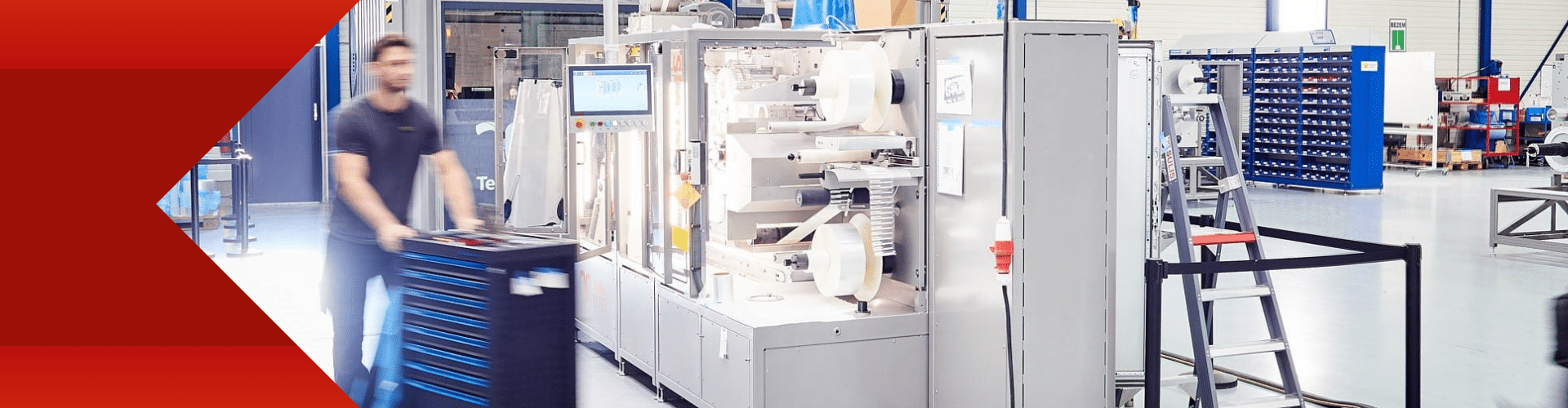
Machines that have operated reliably for years eventually reach their technical limits, often visible in increasing cycle times, reduced accuracy, or growing wear. This does not necessarily mean the entire machine needs to be replaced. By reassessing individual linear components based on current loads and performance, there is often immediate potential for improvement. Below, we explain how we upgrade linear components in existing machines together with you.
Machine optimization
In many cases, machines remain mechanically sound but are limited by production speed, accuracy, or maintenance intervals. Often, the pressure comes from cycle time: the faster a machine can produce reliably, the sooner the investment pays off. However, increasing speed has its limits. Larger motors can deliver more dynamics, but usually require larger drives, more energy, and a heavier mechanical structure.
That is why optimization does not always start with “more power,” but with identifying where resistance, play, or insufficient stiffness occurs. Linear recirculating ball guides are often a key factor, as they support and guide motion with low friction, while load, speed, accuracy, environment, and required service life determine the selection.
Reliable integration of new linear components
A retrofit or re-engineering project requires the same technical rigor as a new machine design. LM Systems therefore performs service life calculations based on at least the required machine lifetime. This ensures that the selected guide, rail, carriage, screw, or linear module matches the actual load and motion profile.
In practice, our engineers evaluate forces, moments, stroke length, speed, mounting position, contamination, lubrication, and available installation space. Only then is the component selected. Our specialized expertise is applied to support you with calculations and design considerations, including machining, lubrication, coatings, and customization.
For every industrial application, we provide an individual solution
improved components
Upgrading linear components in existing machines is particularly valuable when the machine base is still in good condition, but one axis limits performance. Examples include a handling gantry with excessive vibration at higher acceleration, a packaging machine with increasing wear in the guide system, or an assembly line where repeatability declines after millions of cycles. A technical assessment focuses on:
- required cycle time and acceleration
- loads, moments, and stroke length
- required accuracy and repeatability
- environmental conditions such as dust, moisture, cleaning, or temperature
- lubrication, sealing, coatings, and maintenance intervals
- available installation space and integration with existing machine frames
Collaborating with our engineers
Current technology offers more options
Modern linear components provide more possibilities than many older machine designs allow. Consider stiffer profiles, carriages with specific preload levels, sealing options, lubrication systems, or lightweight designs. For example, we supply guides with customer-specific preload, rail machining, and optional sealing or lubrication systems.
However, the best solution is not automatically the heaviest or most expensive option. Excessive preload can increase resistance, while an undersized guide may wear more quickly under higher dynamics. Machine optimization is therefore about finding the right balance: sufficient stiffness and service life without unnecessary mass, friction, or energy consumption.
Our practical perspective
As we often summarize: “For every industrial application, an individual solution.” For existing machines, this approach adds even more value, as the solution must fit within existing dimensions, loads, and production goals. Through customer-specific adaptations and assembly, the result is not a standard replacement, but a technical improvement tailored to how the machine actually operates. Contact us to discover what machine optimization can mean for your application.