


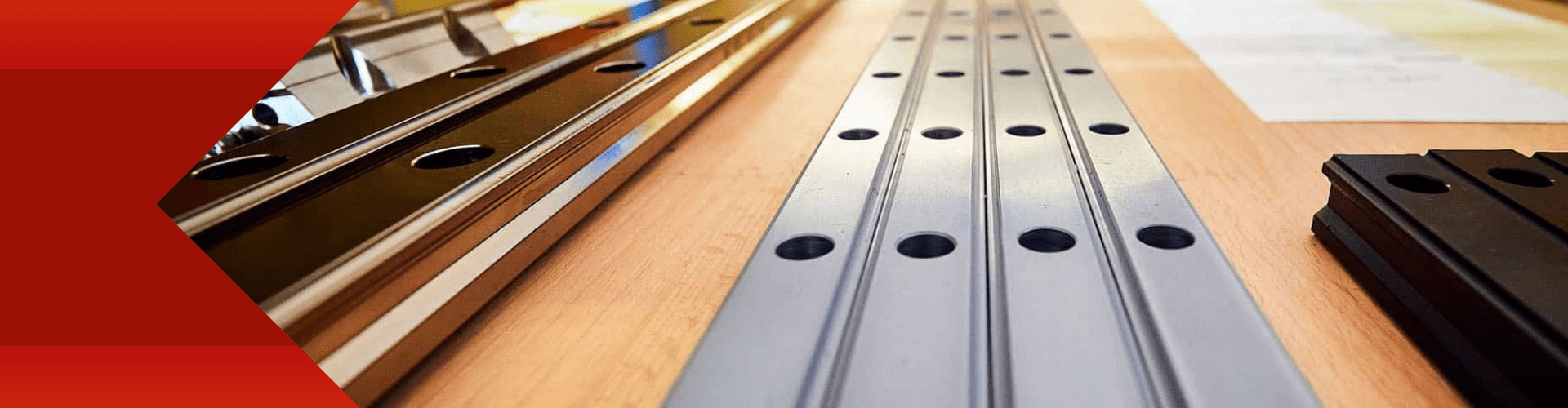
When selecting profile rail guides, the question often arises as to which ISO tolerances apply. In practice, this is nuanced: profile rails and carriages do not fall directly under a single, specific ISO standard for accuracy. Consequently, manufacturers utilize their own accuracy classes, which are generally comparable across brands and, in some cases, align with DIN standards.
Accuracy Classes in Practice
By default, profile rail guides are available in an N-class, or normal accuracy class. This version is typically available from stock and is suitable for a wide range of industrial applications requiring stable and reproducible movement without extremely high positioning requirements.
When higher precision is required, guides are available in H, P, SP, and UP classes. As the accuracy class increases, the tolerances decrease. This directly affects geometric deviations, such as the height difference between the bottom of the rail and the top of the carriage, as well as the lateral deviation between the sides of the rail and the carriage. The more precise the class, the tighter these tolerances are defined.
-
N-class: Normal accuracy, widely applicable.
-
H-class: High accuracy (elevated).
-
P, SP, and UP classes: High to ultra-precision versions with minimal tolerances.
ISO Tolerances and Measured Values
Exact tolerance values are documented in tables provided by each manufacturer for every accuracy class. These tables specify height differences, parallelism, and lateral deviations. It is only possible to define tolerances by referring to these tables, as values vary by type and system size. The choice of an accuracy class is always driven by the functional requirements of the machine, such as positioning accuracy, repeatability, and rigidity.
ISO, DIN, and Interchangeability
While profile rail guides are not directly governed by an ISO standard for tolerances, specific types are available that comply with DIN standards. These DIN-compliant versions allow for interchangeability between rails and carriages from different manufacturers, provided the same accuracy class and geometry are maintained. This is particularly relevant for retrofit projects or when replacing existing guides.
A higher accuracy class places greater demands on the mounting surface. Tighter tolerances for the guide mean that the flatness, parallelism, and fastening of the mounting surface must be more strictly controlled. Therefore, the correct choice of tolerance always results from a balance between the desired precision, loads, mounting conditions, and cost considerations. This ensures the guidance system remains functional and technically aligned with the application.
LM Systems delivers every guidance system custom-configured to meet the technical standards required for your application. Would you like to know which configuration best suits your machine? Feel free to contact us for technical advice.