


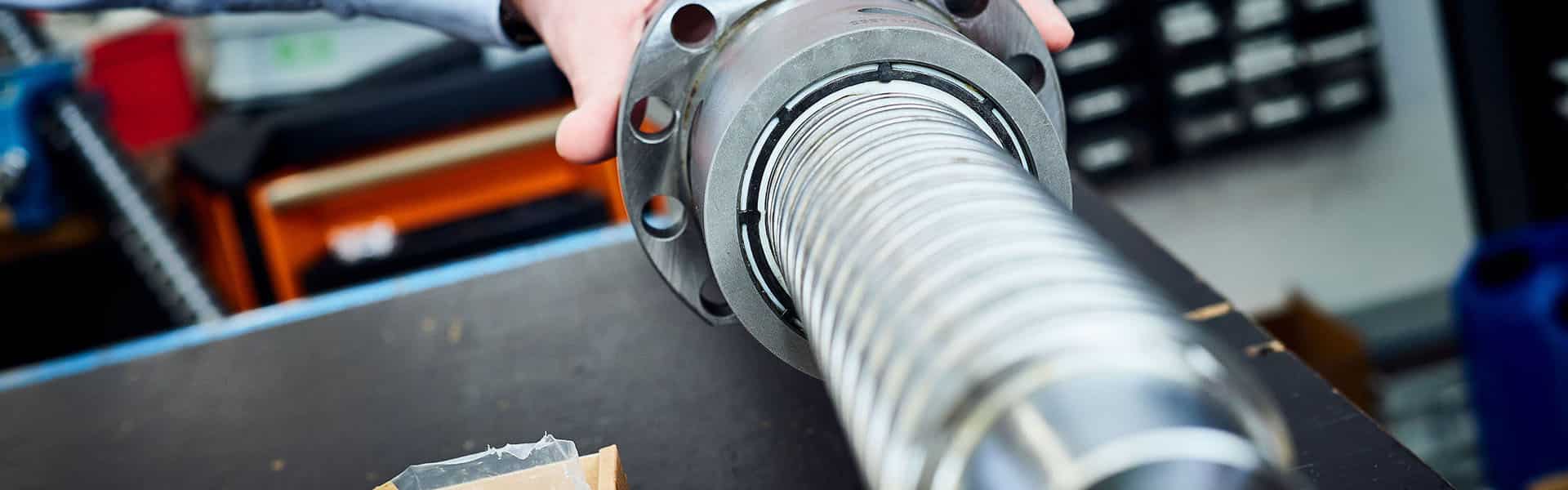
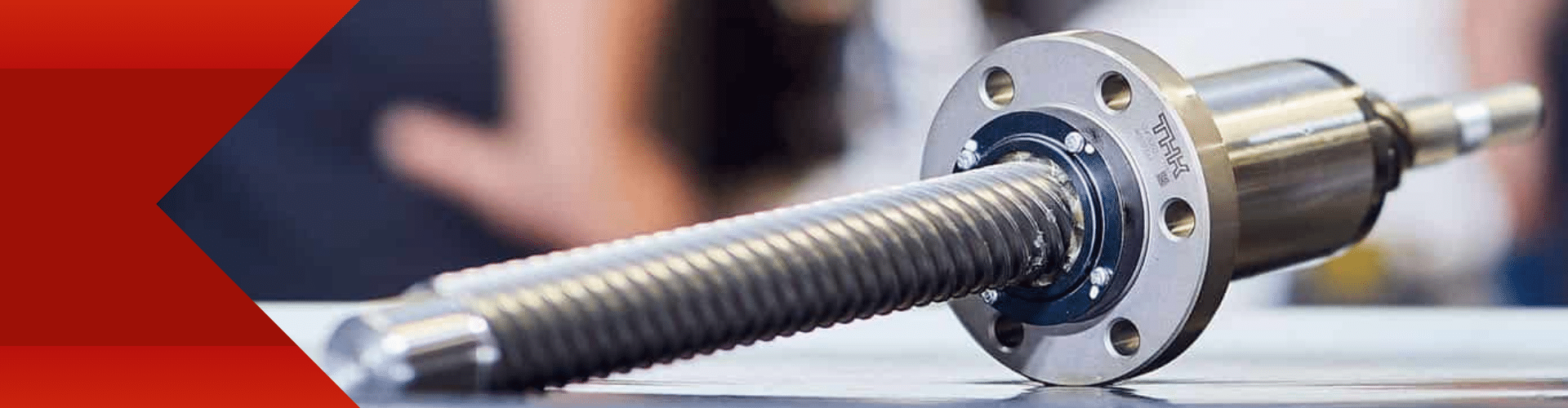
A trapezoidal lead screw forms a robust mechanical drive system that generates linear motion through rotation. While ball screws are often preferred for applications with high dynamics, the trapezoidal thread excels in specific situations such as height adjustments and width adjustments.
The operation of this system is based on the thread geometry. The flank angle provides a large contact surface between the screw and the nut. This surface makes it possible to absorb significant axial forces without the construction failing. For an engineer in machine building, this component is often the first choice when costs must be kept low and speed is of secondary importance.
Choosing a trapezoidal lead screw
The choice for a trapezoidal thread instead of a ball screw is determined by the required speed and the nature of the load. This system is ideally suited for applications with low speeds and heavy loads. In machine construction, we often apply this component in format changeovers where the screw is not in constant motion. Examples include adjusting a guide rail along a conveyor belt or positioning a heavy worktable that then needs to remain in the same position for hours.
The efficiency of a trapezoidal lead screw is lower than that of systems with rolling elements, but this is offset by an important advantage. A trapezoidal lead screw is cost-effective and, in many cases, offers the benefit of self-locking. This phenomenon ensures that a vertical axis remains in position without the motor having to continuously provide holding torque. This reduces the load on the motor controller and prevents unwanted movement in the event of a power failure. However, it should be noted that this friction also causes torque loss during the movement itself.
20% rule
A designer must take into account the buildup of frictional heat between the screw and the nut. In contrast to ball screws, which operate with rolling contact, trapezoidal threads involve pure sliding contact. The energy lost due to friction is converted into heat. Because of this heat generation, the duty cycle is limited to a maximum of 20 percent per hour. This means that in a cycle of ten minutes, the screw may only move for two minutes and must then cool down for eight minutes.
If the screw is subjected to more intensive use, the temperature will rise excessively, which directly and negatively affects the service life of the nut. The material properties of the nut change under extreme heat, causing flank clearance to increase and precision to be lost. For applications that require a higher duty cycle, we often recommend switching to ball screw technology or using special cooling methods and high-performance lubricants.
Impact on service life
The performance of the drive depends entirely on the correct combination of materials and lubrication. We supply screws in steel or stainless steel, combined with various nut types depending on the environmental conditions.
-
Bronze nuts for high loads, regularly lubricated with Klüber Microlube GBU Y 131
-
Plastic nuts such as POM or EX100 for situations where dry running is required
-
Iglidur J nuts for specific low-maintenance applications
-
Stainless steel screws for use in corrosive environments or the food industry
In general, plastic nuts only require a one-time grease or oil lubrication, depending on the environmental conditions. Bronze nuts, on the other hand, require a strict maintenance schedule to control metal-to-metal friction. At LM Systems, we often see that an incorrect material choice leads to premature wear. A bronze nut on a steel screw offers excellent load capacity, but without the proper film-forming lubrication, the nut will quickly suffer from galling.
Environmental factors of a trapezoidal lead screw
Not every environment allows a screw to be continuously lubricated with grease. In cleanrooms or the food industry, open lubrication can pose a risk to product safety. In such cases, we recommend plastic nuts with self-lubricating properties. Although the service life of these nuts is lower than that of an optimally lubricated bronze nut, it eliminates the risk of contamination. In heavy industrial environments where dust and dirt are present, it is important to select a grease type that repels contaminants or to protect the screw with a bellows cover.
Fixed–floating bearing arrangement
To ensure reliable rotation, a lead screw must be correctly supported within the machine structure. A fixed bearing secures the axial position of the screw and absorbs the forces generated during positioning. This bearing must be robust enough to withstand the maximum axial load of the application without exhibiting play.
On the opposite side, we install a floating bearing that provides radial support while allowing axial expansion. This clearance is necessary because the screw can physically lengthen during operation due to the previously mentioned frictional heat. Steel expands as temperature increases. Without this arrangement, the screw would be constrained between the two bearings and could buckle. This phenomenon causes unwanted vibrations and can directly impair the precision and service life of the entire drive system.
Customization and modifications of a trapezoidal lead screw
At LM Systems, our service goes beyond supplying a standard-length screw from the catalogue. We understand that every machine builder has unique requirements regarding installation space and motor connection. That is why we perform complete end machining of the screws in our own workshop. This includes turning bearing journals and milling keyways or flats for couplings.
In addition, we can modify nuts or produce customer-specific flange dimensions. The application of special coatings for increased corrosion resistance or a lower coefficient of friction is also possible. Through this in-depth technical support, we relieve the engineer of additional work and provide the purchaser with the assurance of a ready-to-install component.
LM Systems supplies every trapezoidal lead screw tailored specifically to the intended application. Would you like to know which configuration best suits your machine? Feel free to contact us for technical advice.