


A linear rail is often regarded as a standard component, but in practice every application requires a tailored solution. Loads, contamination, and the required accuracy together determine which type of guidance is suitable. Within industrial environments such as machine building and manufacturing, this alignment is decisive for reliability and maintenance intervals. LM Systems explains how to make the right choice for your application.
What is a linear rail
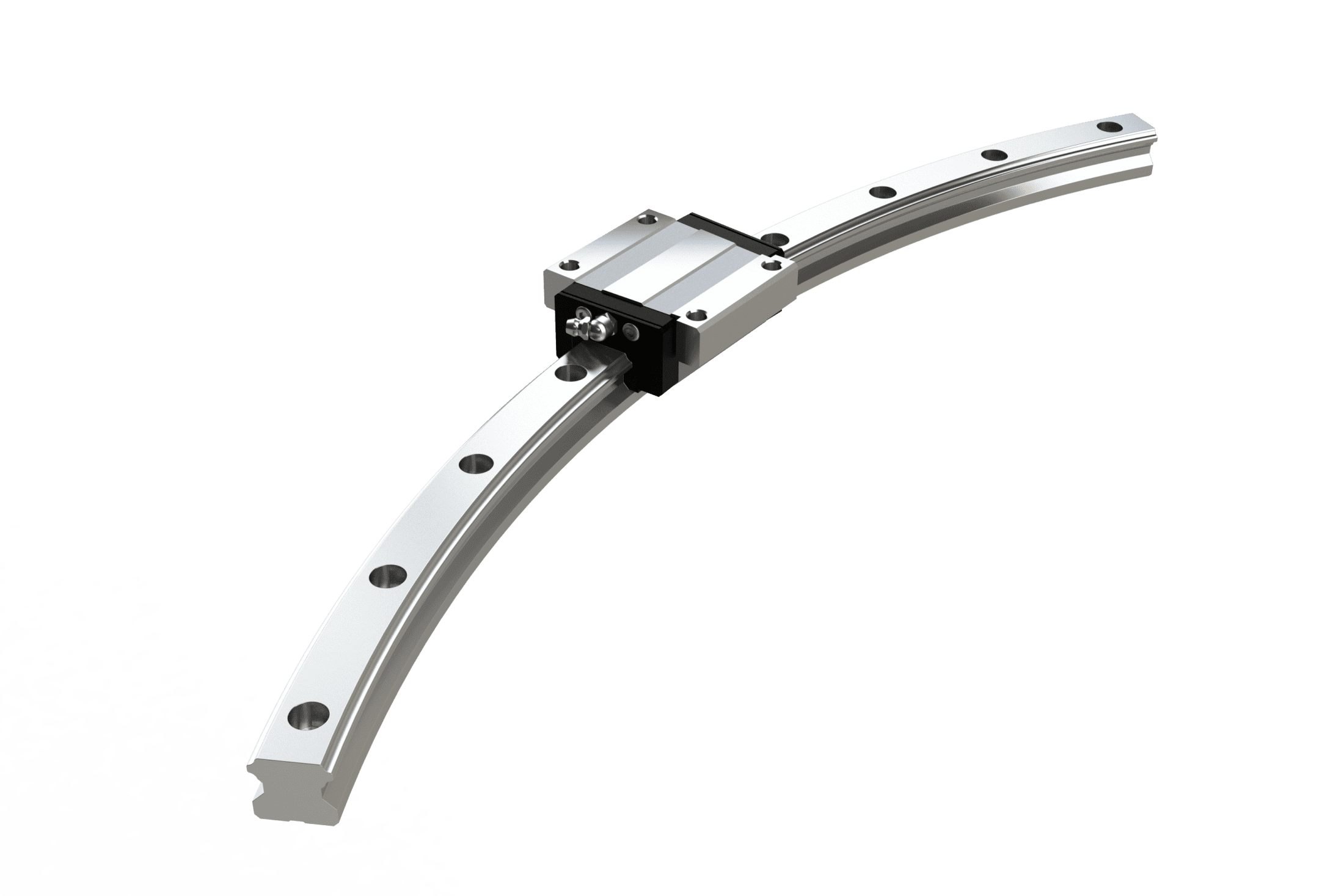
A linear rail is a guidance system that allows a moving component to travel accurately along a fixed axis with minimal friction. In combination with one or more carriages, it creates a stable linear motion. This type of guidance is therefore widely used in machine tools, assembly systems, and handling solutions. The linear rail transfers loads and moments to the machine frame and thus plays a major role in determining the overall stiffness of the system.
Guiding principles in linear motion
Within linear guidance, several principles exist, each with its own characteristics. In practice, the most common are ball bushings, spline guides, and profiled rail guides. A ball bushing is suitable for simple applications with limited moment loads. Spline guides combine linear motion with torque transmission and are used when rotation must be prevented. Profiled rail guides with recirculating balls are used when higher loads, accuracy, and service life are required. The choice of principle therefore depends on forces, available space, and the desired level of precision.
Stiffness and preload of the linear rail
The stiffness of a linear rail is largely determined by the preload of the carriages. LM Systems supplies carriages with zero clearance, as well as versions with light preload C1 or moderate preload C0. A higher preload increases the contact force between the balls and the raceways, resulting in a stiffer and more stable response to varying loads. At the same time, friction increases, which affects drive power and heat generation. For this reason, preload is always matched to the application and the required motion profile.
Each linear rail also has limit values for dynamic and static loads, including moment loads around the different axes. Larger sizes use larger balls and can therefore accommodate higher forces. During the design phase, it is important not only to consider the maximum force, but also the distribution of moments over the carriages. Service life calculations provide insight into the expected operating life under realistic conditions.
Accuracy and repeatability
As standard, linear rails are supplied in the normal accuracy class. For applications with higher demands, accuracy classes H, P, SP, and even UP are available. These classes define tolerances for parameters such as height and parallelism. However, the repeatability of an axis is not determined by the rail alone. The drive system, such as a timing belt, rack and pinion, or ball screw, plays a decisive role. Proper matching of guidance and drive prevents unwanted positioning errors.
Installation in machine frames
Correct installation of the linear rail is essential for predictable performance. The machine frame must be sufficiently flat and rigid to prevent stresses in the rail. Attention must also be paid to alignment and fastening. In industrial environments with contamination, additional seals can be applied to protect the ball circulation. In cases of extreme contamination, LM Systems deliberately avoids recirculating ball guides and instead opts for track roller guides from Nadella Rollon, as these are more resistant to dirt and particles.
In machine building and manufacturing, linear rails are therefore used in applications such as CNC machines, packaging lines, and pick-and-place systems. Depending on cycle time, load, and environmental conditions, the configuration varies. For this reason, LM Systems does not supply standard solutions, but customer-specific assemblies. These may include customized rail lengths, selected accuracy classes, and matched preload.
Why choose LM Systems
LM Systems is the market leader in the Benelux and works with products from THK, a globally leading manufacturer of linear motion systems. As a co-engineering partner, LM Systems works closely with you to select the right linear rail. This is done based on technical requirements, service life calculations, and total cost of ownership. With its own inventory, machining center, and customer-specific assembly, LM Systems offers high delivery reliability. For further information, you can also consult the pages on linear guides, recirculating ball guides, and custom assemblies on our website.
The right linear rail is always the result of technical considerations and practical experience. By working together early in the design phase, you gain insight into performance and service life. LM Systems supports you as an engineering partner and translates your requirements into a reliable solution. Contact us to discover what customization can mean for your application.